
Did your parent(s) talk you through their will? Will they? My guess is probably not. Death in the West is a taboo subject, seldom discussed and therefore feared. I aim to elucidate and analyse some of the prevailing narratives around death.
To begin, I’d like to consider the question – What is death?
a) a biological ‘shut-down’ of a physical body
b) a divinely-determined end to a corporeal life
c) the end of the physical presence of a soul, but not the end of the soul itself
d) none of the above
I do not attempt to resolve this question. I do, however, pose that your answer to this question is formed by culture, and in particular cultural cosmology. Depending on your religious and spiritual outlook, death may be a moment of reincarnation, a point of divine judgment, or a physical and cognitive end.
The way that a community thinks about death can be understood by looking at the rituals associated with the dead body. In Tibet, to give one example, a group of monks perform a Sky Burial for a dead body. A group of monks guide the consciousness from the body with songs and music. Women then crush the bones and cut the flesh from the body. Juniper incense is burnt to summon vultures. Then, as a final act of compassion, the body is offered to vultures as a way of returning the flesh back to nature (Bruno, 2005). The soul is then free and can exist in the sacred sky. This example shows how death is seen as a passage to a sacred and peaceful place, where there is no more suffering.
This ritual is misunderstood in mainstream Western culture. When researching this ritual, I found an article on a website called “Unimaginable Nightmares”. This article saw the Sky Burial as barbaric and grotesque. The treatment of the dead body can cause all manner of reactions. My reason for mentioning this website (while feeling vehemently against the appropriation of any custom in order to satiate a fascination with the ‘Other’), is to show the potency of death rituals to provoke a reaction in others. Our discourses of death are often incompatible with others, such that any other way of treating the dead body is subject to ridicule or disgust. Perhaps this is further evidence that the West treats death as a taboo.
So why does a taboo of death exist? The image that is the header for this blog post was an advert for a funeral price comparison site. It was banned by TFL last year (NY Times, 2018). An ethnographic example of the taboo can be found from Sarah Lamb’s fieldwork in West Bengal. Lamb (an American anthropologist) noticed that her informants were comfortable talking about their own deaths and expressing a sense of readiness for dying (Lamb, 2017:231). As an automatic response, she would disagree, saying that they looked healthy and could live for ten more years. Evidently, there is a Euro-American uncomfortableness in agreeing that someone seems ready to die. This reveals that to Lamb, death was something to be avoided rather than embraced. Perhaps we fear the end of the body.
The taboo of the dead body can test and confront Cartesian dualism. When studying the effects of cadaver dissection on medical students, Carroll et al (2002) found that the experience was mostly positive. One student said that the first cut was difficult, but it soon became apparent that it looks “like the anatomy book and it doesn’t look like a human being anymore” (Barton, 1972). The human body becomes objectified in the medical gaze, such that the Cartesian divide between mind and body may be reinforced. However, the student felt uncomfortable before dissecting the body, suggesting that they associated the dead body with the embodied person.
I argue that there is an anxiety in the West surrounding death. This anxiety produces social taboos, to avoid facing death and acknowledging this fear. Following Bichat’s legacy of ‘vitalism’ (the idea that an inexplicable life force that defends the body from death), fears of death rest on the premise that death is an ontological other (Rose, 2007:43). It could be that the medicalisation of Western society seeks to ease these fears. Science and medicine have transformed our notions of health, such that health becomes a social imperative. The body is no longer an unalterable subject. With medicine and bioscience, we have the power to prolong and end life.
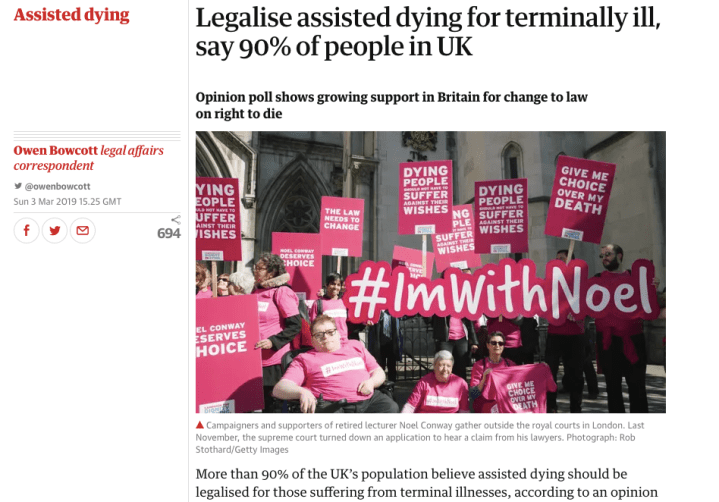
As with many anxieties, they are accompanied by need for control. I pose a somewhat controversial argument: Euthanasia is a product of a Western fear of death. The act of euthanasia aims to regain control of death, and quell our anxieties about the end of the body.
Bibliography
Barton D. The need for including instruction on death and dying in the medical curriculum. J Med Education 1972;47:169– 75
Bruno, E. (Director). (2005). Sky Burial: A Tibetan Death Ritual [Video file]. BrunoFilms. Retrieved March 5, 2019, from Kanopy.
Kleinman, Arthur. 2006. What Really Matters: Living a Moral Life amidst Uncertainty and Danger. New York: Oxford University Press.
Lamb, Sarah. 2017. Successful Ageing as a Contemporary Obsession: Global Perspectives. Rutgers University Press.
Rose, Nikolas. 2007. The Politics of Life Itself: Biomedicine, Power and Subjectivity in the Twenty-First Century. Princeton University Press.
Sinclair, D. W. 2002. Assessing the emotional impact of cadaver dissection on medical students. In Medical Education. 36. 550-555.
https://www.nytimes.com/2018/08/01/world/europe/uk-beyond-funeral-ads.html, accessed 3rd March 2019
https://www.theguardian.com/society/2019/mar/03/legalise-assisted-dying-for-terminally-ill-say-90-per-cent-of-people-in-uk, accessed 4th March 2019
 Anthropology of Ageing