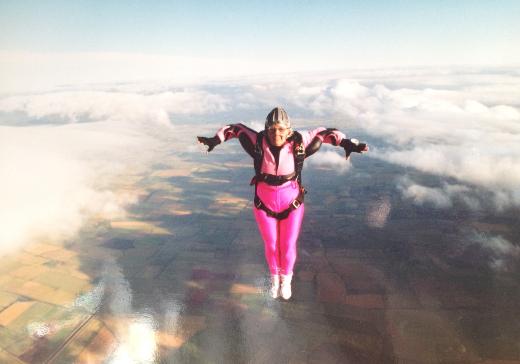
The video below shows Daredevil Dilys, as she is known to family and friends in Wales, performing an independent skydive. Dilys is 82, and has completed over 1,100 skydives for charity, since completing her first jump at the age of 52. Her story has been shared on the “Age of No Retirement” website, designed to question “our internal ageism” and ask us to challenge society’s notions of what the elderly can and should do.
Although Dilys’ bravery and physical courage is admirable, I would like to look at the societal norms underpinning the glorification of her actions.
Daredevil Dilys’ feats are part of the increasing discourse on how to ‘age successfully’. The public narrative of old age has moved on from being a physical internment that degrades both the corporeal body and the mental faculties (if they can be separated!). One aspect of successful ageing is a “high cognitive and physical ability” (Taylor, 2017:126). More recently, the discourse surrounding the ageing body seems to be centred on how to remain active and prevent the burdens of physical and mental decline (Lamb, 2017:2). This is evidenced in the wealth of self-help books aimed at ‘ageing well’, such as Jack Lalanne’s ‘Live Young Forever: 12 Steps to Optimum Health, Fitness & Longevity”.
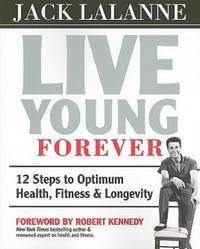
Lalanne’s book seems to reify the youthful body with implicit assertions on the cover that the aged body cannot be fit or healthy.

The successful ageing narrative can be seen as product of neoliberal idealism, in which dependence on kin is to be avoided at all cost (Lamb, 2017:9). In Western modernity, cognitive individual agency and independence helps people to deny the “existential vulnerability” of the body (Kleinman, 2006:7). To decline physically is seen as ‘failing’ in the successful ageing paradigm (Lamb, 2014).
In performing a skydive we see Dilys Price completely reject any sense of her body as being exposed and at risk. Perhaps she does have a sense of being vulnerable, but the narrative of the video shows her as a defiant, resisting body, unafraid of risk.
Daredevil Dilys’ skydives are a manifestation of her resistance to the ageing process, which dictates that she should become less active the older she gets. She proves her lack of corporeal dependence on others by performing extreme sports that challenge even the fittest youthful bodies, and this proves her ‘success’ at ageing. It could be argued that her resistance to the ageing narrative, and determination to ‘successfully’ age reinforces the perception that a natural ageing process is a failing, or is a ‘loss’ in some way.
According to Foucauldian ideas of biopower, Dily’s subersive techniques of the body could be just neoliberal ideals subjected onto her ‘docile body‘ (Pylypa, 1998). Foucault might argue that empowerment is a term we use to mask the proponents of true power (ibid:34). The skydiver, believed to be empowered, is in fact acting within a system that encourages the elderly to prove their resilience, perhaps as part of a capitalist system in which the body is only valued on its ability to produce labour (to take a Marxist stance)?
However, Foucault’s ideas of biopower are not without fault and applying these ideas may be slightly reductive. ‘Successful ageing’ may be simply a narrative, and we should understand how it is embodied and reproduced in society. Perhaps Ms Price’s physical fitness and participation in extreme sports is not a result of the subjugation of her body under the strains of neoliberal ideology, it is an expression of her own ontology? She does not believe herself to be fitting within a certain narrative, and proves this with an extreme performance of corporeal strength and mental stability. I think that her techniques of the body are in fact a way of resisting a common theme of ageing. That is, a decline of the body, regularly espoused by the mainstream media. To take a phenomenological perspective of Dilys’ actions would be see her actions as embodied free will (her will being to age as she pleases).
However, assuming that Sarah Lamb is right; successful ageing is a pervasive narrative within Western society, and that Daredevil Dilys epitomises a Euro-American desire for individual freedom (founded on neoliberal principles), a comparison to a community founded on different ideals will be useful. Anna Corwin studied a group of 150 Catholic nuns living in a convent located in the mid-west United States. They seemed to age healthily and face fewer age-related diseases (Corwin, 2017). Corwin observes that although the nuns seem to ‘age successfully’, they do precisely because they are not caught up in ideas of individualism and independence. This is because death is seen as a conduit, from an embodied form of personhood to another form. The communal living structure instills a system of interdependence. Dependence is not seen as a weakness, but a natural outcome of lives ‘in service’, in which every body is dependent at some stage. Agency is constructed within an understanding of “divine authority”(ibid:102) and as such agency is located out of the body, and held, ultimately, by God. Here we see a conception of agency that is not founded in secular, neoliberal ideology, and as a result, produces a different relationship to the ageing process. The nuns with which Corwin worked did not see death and ageing as final, just the end of the corporeal experience. Physical decline did not signify a decline in personhood, as personhood was not trapped in a certain stage of life.
To conclude, the successful ageing narrative is a very powerful part of the ageing discourse in Western society, and contributes to the desire for independence and reluctance to accept corporeal decline. Whilst immediately this doesn’t present any social issues, I think that an extension of the successful ageing narrative is the binary view that there is a ‘normal’ and an ‘abnormal’. Successful ageing is seen as the ‘right’ or ‘favourable’ way to age, meaning that anyone who exists outside of these norms, for example elderly people made dependent by illness, may feel excluded and abnormal. An inclusive way forward would be to acknowledge of the inevitable decline of the body, whilst also encouraging this decline to be meaningful and culturally respected.
Bibliography
Corwin, Anna (2017) Growing Old with God: An Alternative Vision of Successful Ageing among Catholic Nuns. 99-111. in Lamb, Sarah (2017) Successful Ageing as a Contemporary Obsession. Rutgers University Press.
Kleinman, Arthur. (2006). What really matters: Living a Moral Life amidst Uncertainty and Danger. New York: Oxford University Press
Lamb, Sarah (2017) Successful Ageing as a Contemporary Obsession. Rutgers University Press.
Pylypa, J. (1998). Power and Bodily Practice: Applying the Work of Foucault to an Anthropology of the Body. Arizona Anthropologist, (13), pp.21-36.
 Anthropology of Ageing